
CONGRESS HISTORY

HISTORY AND PREVIOUS EDITIONS
The International Association for Semiotic Studies (IASS-AIS) was officially founded in Paris in 1969, following several years in which semiotics became internationally established as a scientific discipline. Its origins can be traced to academic meetings held in the early 1960s and to the first international conference on semiotics, held in Poland in 1966. Since then, the Association has played a decisive role in establishing semiotics as a field of knowledge, bringing together some of the discipline’s most influential figures, including Émile Benveniste, Umberto Eco, Julia Kristeva, Roman Jakobson, Yuri Lotman, and Thomas A. Sebeok, while fostering an international academic community. The journal Semiotica became its principal forum for scientific dissemination, and the World Congresses of Semiotics, held periodically since 1974, have become a leading venue for debate, interdisciplinary cooperation, and the international advancement of research on meaning-making processes.
Thanks to this sustained work, the IASS-AIS remains the foremost global organization for the development and coordination of semiotic research.
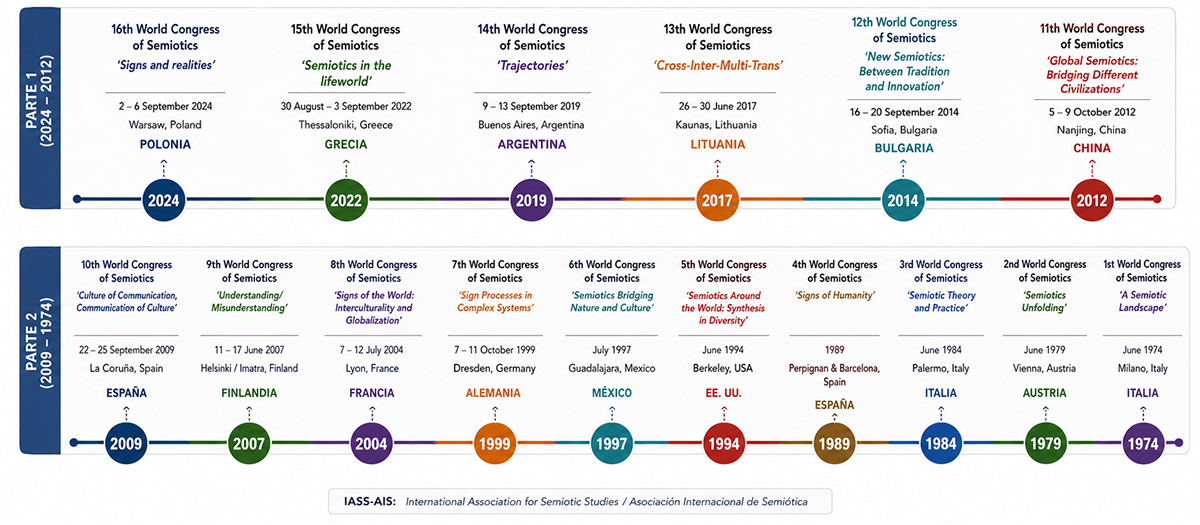
More than a chronological sequence of scholarly gatherings, the World Congresses of Semiotics reveal the continuities and transformations that have shaped the development of semiotics over the past five decades. The theme of each edition reflects the evolution of the discipline’s questions, approaches, and objects of study, as well as its growing dialogue with diverse cultural contexts and fields of knowledge. The timeline below summarizes this historical journey, highlighting the host cities, dates, and themes that have guided each Congress from Milan (1974) to Warsaw (2024).
WORLD CONGRESSES OF SEMIOTICS (IASS–AIS)
Timeline of previous congresses
Reference:
International Association for Semiotic Studies (IASS–AIS). (n.d.). Short history. iass-ais.org/presentation-2/short-history/